
Since it’s the end of convertible season for much of the northern hemisphere, for some inexplicable reason your TTS team is leaning-in hard on them! We’ve already talked about the budget cars, but what if you’re looking for upside? Generally speaking, my advice to folks interested in buying a car with potential upside in value has been to just look at whatever I’ve sold in the past year or two. Almost invariably if I’ve sold it, value has subsequently skyrocketed. But like all car adventures, there’s risk in that strategy and to be honest I’ve sort of slowed-down my selling recently so there are fewer cars to choose from that normally occupy that space! So with that in mind, here is a look at the current market biased by my own automotive tastes, and six convertibles that I think are likely to see an uptick in value – at least enough to help you keep your shirt and maybe end up with a little extra if and when you go to sell.. Or your heirs do.
First things first: the assumption here is that you will do your due diligence when selecting one of these cars – that is to say, buy the best example you can reasonably afford. Don’t buy a sketchy wreck of a car with a spotty history and in need of tons of love (read: cash infusion) in hopes that a) you can fix it up for cheap and flip it, or b) even crappy examples will rise with the tide. Neither of those strategies works reliably! At the same time, we’re not suggesting that you find a delivery mileage, perfectly stored and maintained garage queen. Those cars will always command a premium, but you’ll also pay that premium upfront. Besides, we are big fans of owning cars that we can actually drive. If the value is going to drop from the original purchase price with each passing mile, what’s the point? Certainly seek-out low miles for the year/age (I like to say 5K or less per year, total less than about 70K) or even slightly higher mileage but in exemplary condition with full history, but we’re not talking museum pieces here. So with that, on to the cars!! (In alphabetical order…. I prefer them all!)
1971-1994 Alfa Romeo Spider
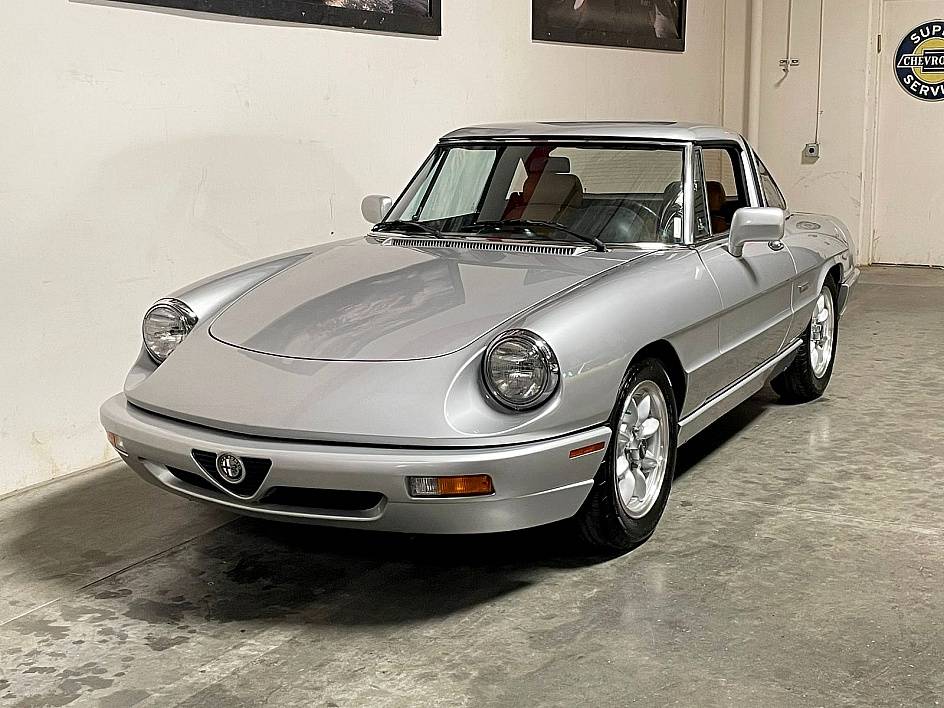
I love Alfa 105/115 series Spiders. My first car ever was a green 1977 Series 2 Spider. It was at the same time terrific and terrible. We bought it rusty in 1984 and it didn’t improve with age, sadly. These days, when Miatas, MGs, TR6s, and even Fiat 124s have ticked-up in price, for some reason Alfas still seem to be very reasonable – especially considering the overall package: sweet, durable twin cam motor, Pininfarina styling that looks as much baby Ferrari as anything, choice of carbureted, chrome-adorned classic or fuel injected, modernized throwback. All of them offer one of the easiest tops in the business to put up or down, reasonably spacious 2-seat cabin and enough trunk space for two to take a long weekend, killer heater on a cool morning, and one of the best exhaust notes in the business.
For our money, the sweet spots would be an early (1971-1974) Series 2 with the small chrome bumpers like this sweet ’76 or a last-of-the-series 1991-1994 Series 4 like this silver beauty. A later Series 2 with a bumper conversion can be an attractive prospect, although sellers often want to recover their spend on them. Likewise, although the Series 3 is arguable the least popular with its ginormous rear spoiler and plastic adornments, although the Quadrifoglio model with the red and grey interior may be an attractive prospect if the spoiler doesn’t bother you – double points if it still has the original hardtop!
The primary fail point on Alfa Spiders is rust. Ask me how I know. Look in the rockers, jack points, rear wheel wells, spare tire well, and well, everywhere. Electrical problems happen, but these are pretty simple cars. My ’77 never stranded us in 7 years of ownership, except one time when I had to whack the battery. My ’87 did once, and it was a fuel pump relay. So there you go. These get an A+ for smiles per mile, and they’re getting less and less common at Cars & Coffees. Expect to pay $7,500 – $20,000+, depending on year, spec and your negotiating abilities.
1996-2002 BMW Z3
This brings us to the Germans, first of which is BMW…
(Jonathan, who owns the Z3 pictured, enters the chat.)
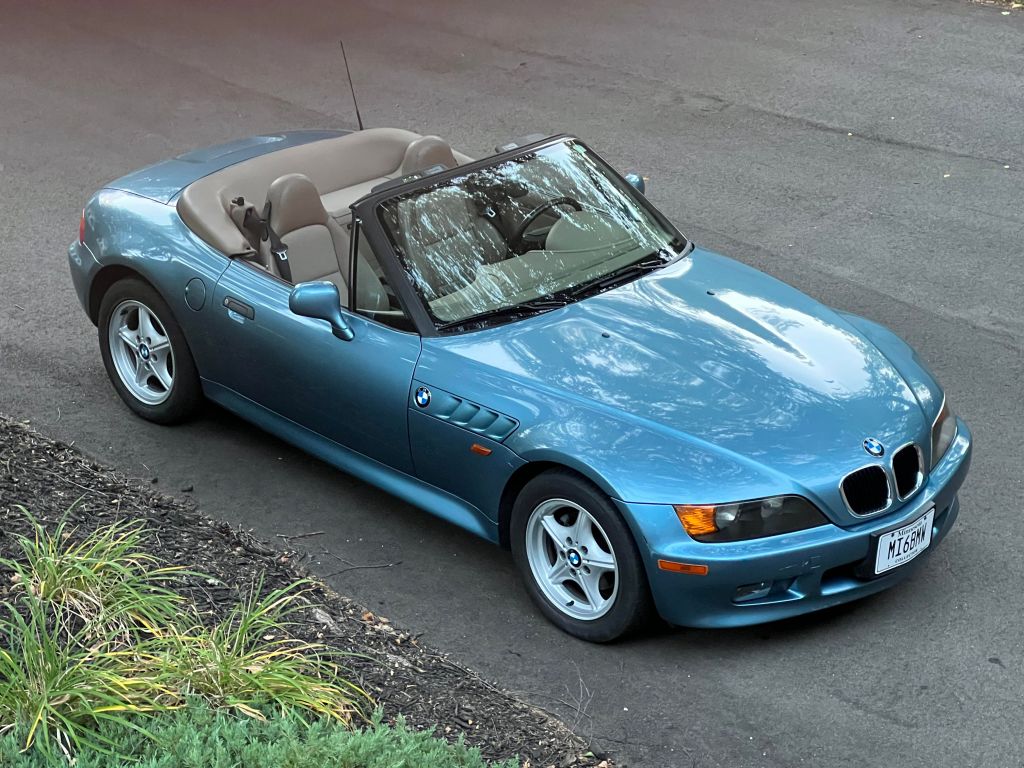
Hold on. If we’re talking about BMW’s re-entry into the roadster world, I’m going to barge in. After Mazda’s fantastic and frankly unexpected success with the Miata, the German manufacturers raised their stoic heads and took note. Mercedes released their SLK, Porsche the
Boxster, and from the folks in Munich (via Spartanburg, South Carolina) we got the BMW Z3. All were two-seat open-top funmobiles, and all sold well – but it was BMW’s Z3 that was most true to the traditional ragtop front-engine, rear-wheel-drive roadster.
We talk a lot around the (virtual) TTS Scotch cooler about cars the market has mostly overlooked. Sadly, a BMW Z3 without a factory M badge seems to fall into that category. Sure, an M Roadster – powered by either BMW M3 engine of the time – will get some love, but the
more garden-variety four- and six-cylinder models are definitely less loved in the market, and prices and time-on-sale reflect that.
Preference at the aforementioned cooler between pre- and post-facelift Z3s is split, but buyers shouldn’t be hung up on specs. The early narrow-body four-cylinder cars are the originals. The
first six-cylinder cars grew hips to cover the wider rear tires. The Y2K facelift brought revised rear styling, updated engines, and a mildly revised interior. All the six-bangers are point-and- squirt weapons, while the 96-99 four-cylinder is more of a momentum car (think grownup Miata).
From the golden age of the company, Z3s make the best use of the BMW parts bins; the important oily bits were all sourced from the iconic E30 and E36 3 Series carlines. All Z3 variants are highly tossable on the backroads with more than enough power to cope with modern
traffic. We’ve recently seen nice examples from about $6,500 up to about $16,000. Here’s an example of a pre-facelift silver-on-black 1998 Z3 2.8 for $10,995. The five-speed manual transmission, power top (of debatable merit), and what appears to be the clean original
condition are all compelling. It would be worth an email to verify the presence of seat heaters.
Check for VANOS noise, any records of cooling system component replacement, and make sure the rear differential mount welds in the trunk are solid. If that all checks out this could be a good one.
Our advice? Buy any one you like and drive the wheels off it.
1988 – 1996 Jaguar XJS
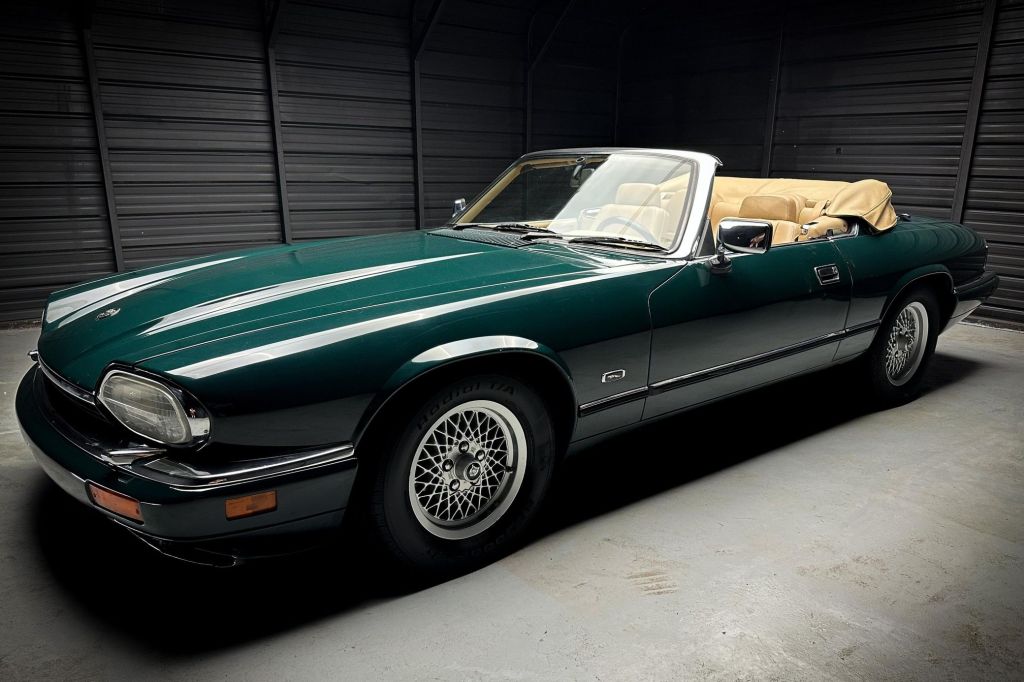
I came very close to buying a Jaguar XJS Convertible last year. Available with either inline-six or V12 engine engines, these cars have classic long hood, short trunk styling but in a reasonably large scale. They came in both two seater and 2+2 configurations and offer a remarkable presence for a relative pittance of a price. Very nice examples start around $8,000 and you can pay as much as $30K plus for one, but you really don’t need to. Have a look at this handsome black on tan 1991 V12 with just 36,000 miles and a buy-it-now price of $19,950 or best offer for example. Wait – did I mention that XJSs were available (in very limited quantities) with a manual transmission? Have a look at this facelifted black on black 1994 six cylinder equipped with a Getrag 5-speed manual. Reserve was not met as of this writing, but can’t be far off.
I’ve actually owned a Jaguar with this transmission – a 1995 X300 XJS 3.2 imported from Spain. The engine/gearbox combination is well-suited to those like me who prefer to “row their own”, but I have to admit that apart from the rarity I think I’d rather have the slushbox on this one. Ultimately, these cars are fabulous boulevardiers, and while they do handle well, if you want a sports car, buy a sports car. Our pick in XJS land is a facelifted (mid-1991-1996) 4.0 inline-six automatic in British Racing Green with biscuit interior. Add heated seats and functional climate control and you’ve got a modern classic aristocratic Brit (didn’t Princess Di drive one for a while?) you can enjoy through at least three seasons (where I live, anyway), and more if they keep the salt off the road.
When you consider that the 4.0 came with 245hp/289 lb-ft of torque versus the V12’s 318hp/336 lb-ft, with fuel economy at 13mpg for the V12 and 19 mpg for the six, and 0-60 at 7.5 seconds in the V12 and 8.4 in the six with top speeds of 153 and 140, respectively, I would argue that the choice comes down to whether you have it in your mind that you must have the smoothness of the twelve. Neither car is a rocketship – plenty fast, but nothing that’s going to win the stoplight grand prix. And frankly, if you wrench on your own cars, the six will be much easier to work on and on your wallet. Trust me.
1991-2002 Mercedes-Benz SL500
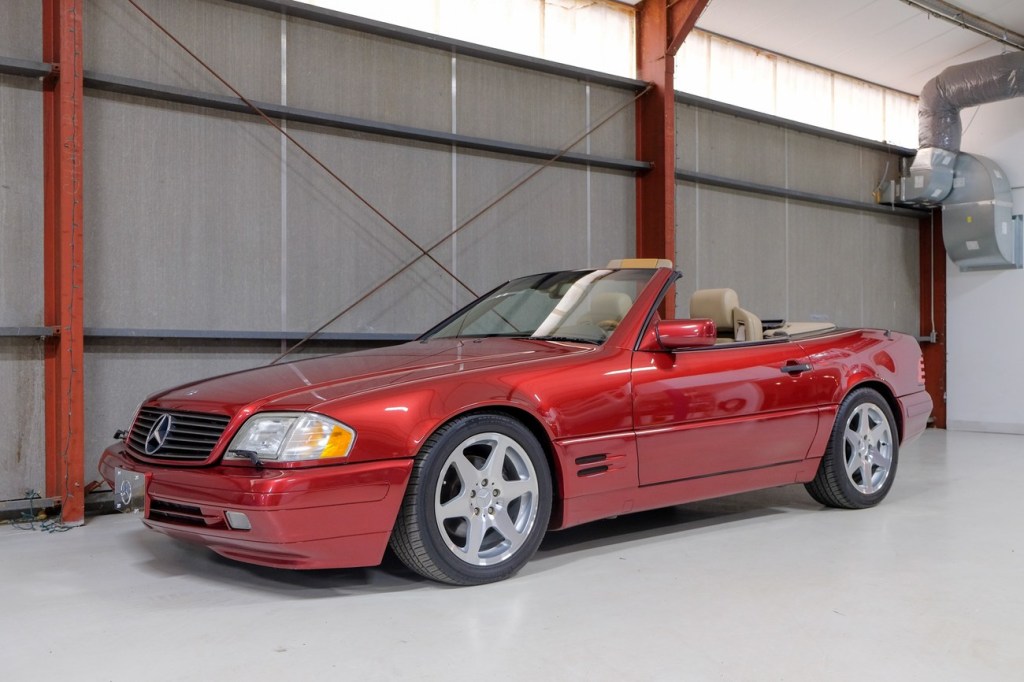
Of all of the cars we’re pontificating about today, this is the one where I have most recently put my own money where my mouth is. Of course, that would strongly suggest that now is the time to buy because recently I’ve started getting those little pangs of guilt that I don’t drive it enough and should maybe consider selling… Like I said above – as soon as I do that, value of these is liable to quadruple within hours. I kind of wish I was kidding.
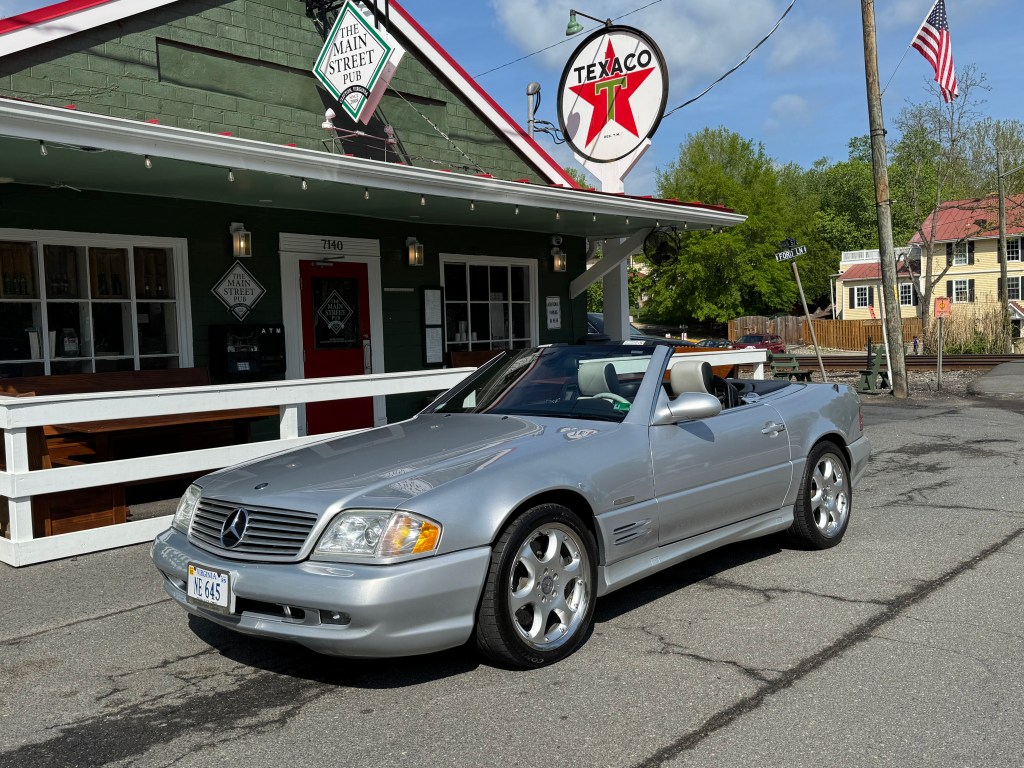
The R129 SL was the last Mercedes to bear the “SL” moniker that was designed to a standard – “The Best or Nothing”. The styling is very much of it’s time, and the 129s look very familiar – inside and out – to anyone who has spent any amount of time in a Mercedes from the mid/late-1980s right up through 1999. Functionality and quality were of ultimate importance, and I can tell you that the R129 is among the most solid, planted classic convertibles you’re likely to drive – ever. I’ve never had anything like it. Sadly, it seems that to a lot of folks these are still just used cars. Maybe not as flashy as some contemporary luxo-convertibles, but arguably the best of them all. I am partial to the V8 models – both the earlier M119 DOHC delivering 322hp and the later, supremely durable 302hp M113. Despite the lower power, the later motor – at least in my fleet including an ML and and SL, and previously a couple of E55s – has been supremely reliable.
Prices for good R129s start at about $7,500, and can go as high as $40K+ for a low mileage 2002 “Silver Arrow” final edition. The sweet spots in R129 world for me are the 1997 M119-powered 40th Anniversary models finished in Crimson Metallic and limited to just 500 examples, and the M113-powered 2002 Silver Arrow “run out” edition – limited to 1450 examples for North America (in SL500 trim, there were an additional 100 SL600 Silver Arrows) and wearing unique engine-turned gauge and shifter surrounds, two-tone leather interior, black birds-eye maple wood trim, and BBS 3-piece wheels – like this reasonably-priced example. Silver Arrows also came with a briefcase full of swag, but most of those have been lost to basements and the like, and when you do find one for sale asking prices are frankly ridiculous. Better deals can be had on more ordinary R129s in comparable condition, but potential upside will be lower. We like an R129 with heated seats (standard in many of the special models), and buyers may want to hold-out for one with the pricey glass “Panorama” hardtop. My hardtop sits in a corner of the garage, so I didn’t go that route.
For folks considering any R129, look for evidence that the hydraulic cylinders for the top mechanism have been replaced – they WILL fail at some point and the job can cost in the neighborhood of $4,000 to be done correctly. Pre-1996 cars had the soy-based biodegradable wiring harnesses, so look for evidence those (all 11 on later cars, 12 on earlier cars) have been replaced. M119 engines tend to leak more oil than M113s from places like valve covers and cylinder heads, so check for those. On the M113s look for leaks near the oil filter housing. Otherwise, small electrical gremlins typical of most 1990s German cars may creep up, and do a general check-over for rust.
1997-2004 Porsche 986 Boxster
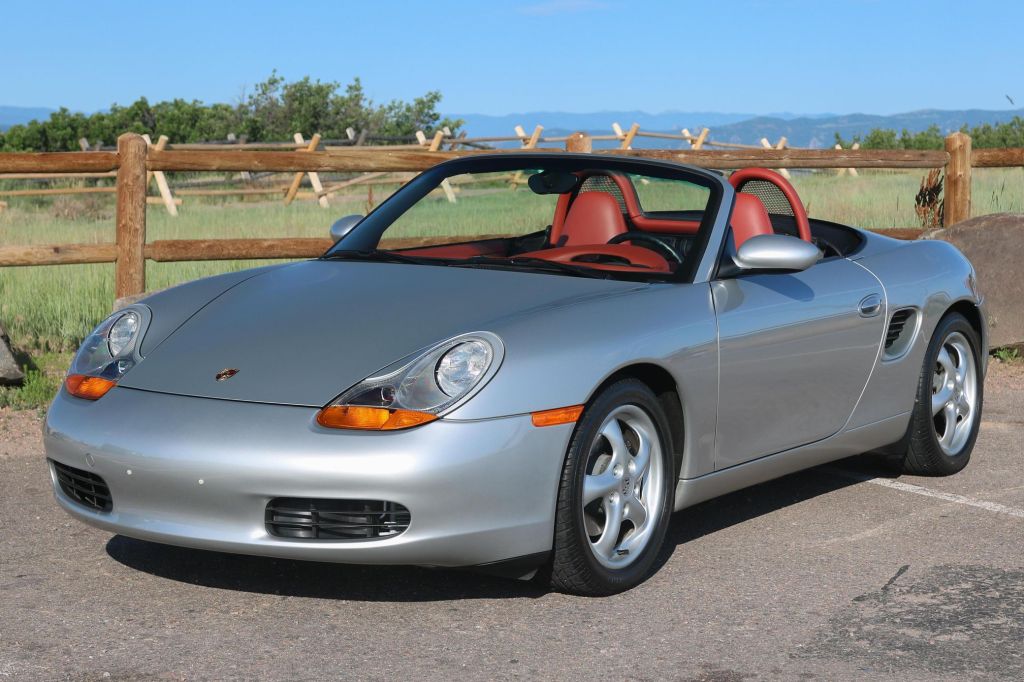
There are still Porschephiles who will tell you that the Boxster isn’t a “real” Porsche. Of course, the same was said about 912s and 914s, then the 924s and 944s, and, well, you get it. Frankly, I might agree on the 924 – wasn’t that really supposed to be an Audi? Now the 924 Turbo and the later 924S – well, those were definitely Porsches. But I digress.
I’ve actually owned two 986 Boxsters – both 2000 model year, both Speed Yellow on black. One was a base 2.7 liter 5-speed, and the other was a Boxster S with the more powerful 3.2 and 6-speed manual. If I’m honest, apart from the lack of heated seats to coddle my precious posterior, I preferred the base car. The S was obviously faster, but the 2.7 felt a little freer-revving and you could use more of the power in the kind of backroads driving I like to do. I’d want the S in a race, but the base most of the rest of the time.
Porsche snobs used to believe that a car had to be rear-engined and aircooled to be a proper Porsche. Then when the 928 came along they seemed to allow an exception for a powerful grand tourer – front engine, coolant, and all. Well then the 944 Turbo came along, and it was fast and handled well, so it got a pass. And then the company nearly went bankrupt long about the early 1990s. Enter the Boxster.
The Swabian company whose entire lineup was comprised of small, nimble, 2-seat or 2+2 sports/sporty cars, sort of lost sight of the lower end of the sports car market, and what they did offer in the 968 – basically a facelifted 944 – was both dated (the overall design dated to the early 1970s) and expensive. They needed something for future 911 owners. Enter the Boxster.
Numerous sources will tell you that the Boxster basically saved Porsche, and allowed them to keep making high-end cars while filling a void at the more affordable end of the market. The fact that with its mid-mounted flat-six engine the Boxster actually handles better than a 911 was just icing on the cake. A couple of years after its introduction the S model was released. The bigger motor coupled with the inherent balance of a mid-engined car made for internal competition for the substantially more expensive 996-chassis 911. Moreover, the interiors were almost identical from the front seatbacks forward, and the sheetmetal from the A-pillars forward actually was identical – save for some changes in the headlights of the updated 996.2. This gave the 911 crowd much angst.
Fast forward to today, and many Boxsters have been neglected as the ugly stepchildren of the brand. But much like the 912s and 914s that survived a similar response, nice 986s are starting to come into their own. Drivers who are not concerned with status but rather on the driving experience have rediscovered the joy that is the Boxster. In retrospect, one of the reasons I got out of Boxsters was to get into 911s, but I genuinely prefer the way the Boxster drives. I’d tell folks who can look beyond the badge to seek-out a Boxster in the “original” silver on red akin to the original show car, one in an interesting color (again, I like the yellow ones, but they came in blue, green, and some gorgeous dark reds) or the one om my “buy” list: the 2004 550 edition like this one of which just 1,953 were produced, all with the extra horsepower, all in GT silver, and some with the gorgeous dark brown leather interior. Prices start around the $7K mark, and can top $40K for the best of the best. You can get a gorgeous C&C-worthy driver for less than $15K. And you’ll love it. 911 what?
2000-2005 Toyota MR2 Spyder
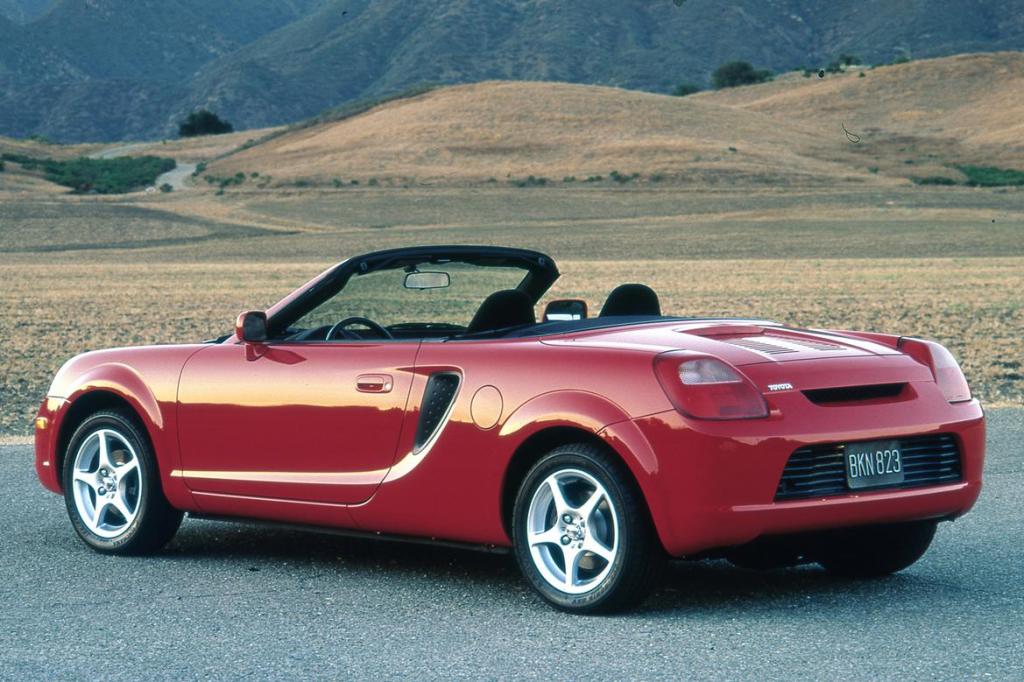
The original Toyota MR2 was a boxy, very 80s thing. “MR2” stood for “Mid-Engine, Rear Drive, 2-seater” – and the two generations subsequent to that original have followed that same format – albeit in very different skins.
The second generation MR2 looked sort of like a bargain Ferrari – especially in red with tan interior. It was available with a turbocharged engine that turned it into a pocket rocket, and prices for those have already headed north. You can still find ratty, ridden-hard-and-put-away-wet examples, but you don’t want one of those. Well, this one guy at my local cars & coffee has a pretty cool one, but that’s a different article.
The third generation MR2 added the word “Spyder” to the moniker (note: I LOATHE when folks spell that word with a “y” instead of an “i” – I think it goes back to my Alfa days, but it’s like fingernails on a chalkboard. OK. end of rant.) to indicate a little roadster whose top goes down. The styling was very much Toyota of the time – attractive, if a little homely and conservative. It’s interesting that one can make a 2-seat roadster look a little plain, but at Toyota they succeeded. Still, as time has gone on, these cars have aged pretty gracefully thanks in no small part to that conservative if somewhat timeless styling.
The MR2’s main competition what new was the aforementioned Porsche Boxster. I mean, they were in completely different brackets, but for the U.S. market they were the only affordable mid-engined convertibles one could buy – and the Toyota, as you might imagine, cost significantly less than the Porsche while offering comparable balance and handling. To be fair, it competed with lots of cars – comparable in price to the Mazda Miata, a little more exotic, maybe, due to its configuration. It also competed to an extent with the BMW Z3, Mercedes SLK, and Honda S2000. But like the Boxsters, because it was relatively affordable new, many are now in varying states of disrepair. You can buy a cheap MR2 Spyder all day long for $5 large, but you don’t really want that car. Pay $10K or a little more, and you can get a beauty. Spend $15K and you can get this clean green machine.
There are those who liken the MR2 Spyder to the original Lotus Elise: they’re both mid-engined, and both have Toyota inline 4-cylinder powerplants. Truth is, the MR2 came with the 1ZZ motor, and the Elise came with the 2ZZ motor. They share a block, but little else. That said – are you thinking what I’m thinking, Pinky? Same block means fairly easy swap, does it not? Not only does it, but it’s a fairly popular thing to do. Want an MR2 that will stand apart from the crowd? Buy a very clean one, do the swap (a quick eBay scan puts 2ZZ prices right around $3k), and drive it like you stole it. Fact is, unless it has delivery miles, this swap is not likely to hurt value, rather will more likely boost it. In clean original or tastefully upgraded condition, these are sleepers waiting to wake up. Get in while you can. Just look at what has happened with Honda S2000s, and well, a lot of other sporty Japanese steel.
_______________________
When all is said and done, in this day and age of global/national marketplace and rampant speculation, any of these cars is on the verge of going up in value. Heck, even if they don’t: if you choose wisely, don’t overpay, and take good care of it, you’d be very likely to get your original investment back out of any of them! Which would you choose, or what cars would you add to the list?
 Totally That Stupid
Leave a comment