

When Infiniti first hit the US market in 1990, their primary target was the luxury sedan segment then dominated by the likes of Mercedes-Benz, BMW, Jaguar, and I suppose Cadillac and Lincoln if one was of the “Buy American Only” mentality in those days. Honda had brought Acura to market a few years earlier in 1986, but they seemed to be aimed more at the “premium” segment that was the stomping ground of Audi, Volvo, Saab, and the like rather than the outright luxury marketplace. Toyota had Lexus, and Nissan had Infiniti. The luxo-wars were on, with the Japanese offering remarkable value in large sedans that were arguably as good or better than the competition – with Toyota taking square aim at the Mercedes-Benz E- and S-Classes with a little more of a luxurious spin, and Infiniti putting the sportier BMW 5- and 7-series in their sights.
But while these excellent, competitive large cars – the Infiniti Q45 and Lexus LS400 – were wowing the reviewers, these new brands could not subsist on a single model in their showrooms. Acura had the Integra to complement the Legend, while BMW and Mercedes offered coupes and convertibles in addition to their larger cars. While Lexus initially opted to add a smaller, Camry-based sedan in the ES250, Infiniti went the route of a luxury personal coupe and convertible – along the lines of the contemporary BMW 3-series and Mercedes-CE (although the 300CE Cabrio was still three years away in North America) or even the Mercedes SL convertible. Like Lexus, rather than engineer something brand new right off the bat (keep in mind this was a totally new brand in untested waters) Nissan looked at their model lineup for something suitable. Sure, the M30 lacked the vault-like solidity or ultimate quality of the contemporary Mercedes coupe, it wasn’t as far off as folks might have expected.

What they came up with was the Nissan Leopard – a boxy coupe available to much of the rest of the world, but not something sort-of already available Stateside. Even in those days, many American enthusiasts were enthralled with the idea of JDM cars that were now out of any sort of reach thanks to strengthened draconian laws related to grey-market imports a few years earlier, so all of a sudden we were to be on the receiving end of something special – with very period Japanese boxy, angular styling both in and out. It also came with substantial standard equipment including power windows, air conditioning, “sonar” automatic suspension, anti-lock brakes, airbag, a power top for convertible models, and even a Bose stereo. Of course, for the princely sum of $34,100 (in 1992 dollars) for the convertible – or about $77,000 in 2025 dollars – it should have.

One thing the M30s sadly did not come with was a manual transmission. Many saw this as a missed opportunity, as the Acura Legend coupe could be had with one, and it would likely have made the middling 165hp, 180 lb-ft 3.0 liter V-6 just a little more enthusiastic about getting on with things. It wasn’t catastrophically slow, especially once going, but 0-60 took a leisurely 9.7 seconds. Anecdotally, folks who have installed manual transmissions subsequently talk about achieving the same in about 8 seconds. Still a tad casual by modern standards, but a marked improvement nonetheless. For a company trying to be the sporting Japanese BMW to Lexus’s Mercedes, this was probably not the smartest marketing move ever. But what do I know?

Sitting here in 2025, things are a little different. People – collectors – clamor for the boxy glory of 1980s and 1990s Japanese cars, and there are whole communities dedicated to the RAD movement. A lot of cars from this period in good to excellent condition easily sell for well over their original MSRP – look at sites like BringaTrailer for transactions on cars like Honda Preludes, Acura Legends, and the like. Just, wow. If we only knew then… But very often collectors are stymied by that automatic transmission – surely a proper enthusiast car can’t come in an automatic, right? That’s a debate for another article. At least the M30 – unusually – comes with rear-wheel drive! I’d argue there are still a handful of very cool RAD machines from the 80s and 90s that would be a hoot to own and drive around and take to your local cars & coffee, and this car is one of them. So is the Subaru SVX (also sadly automatic only but still very cool), but again that’s another article..

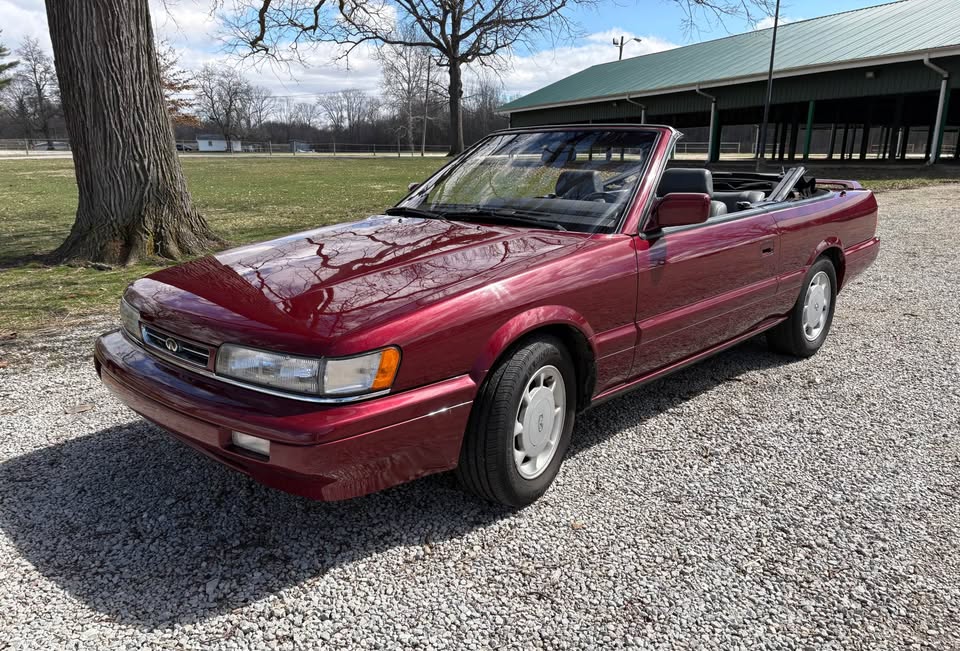
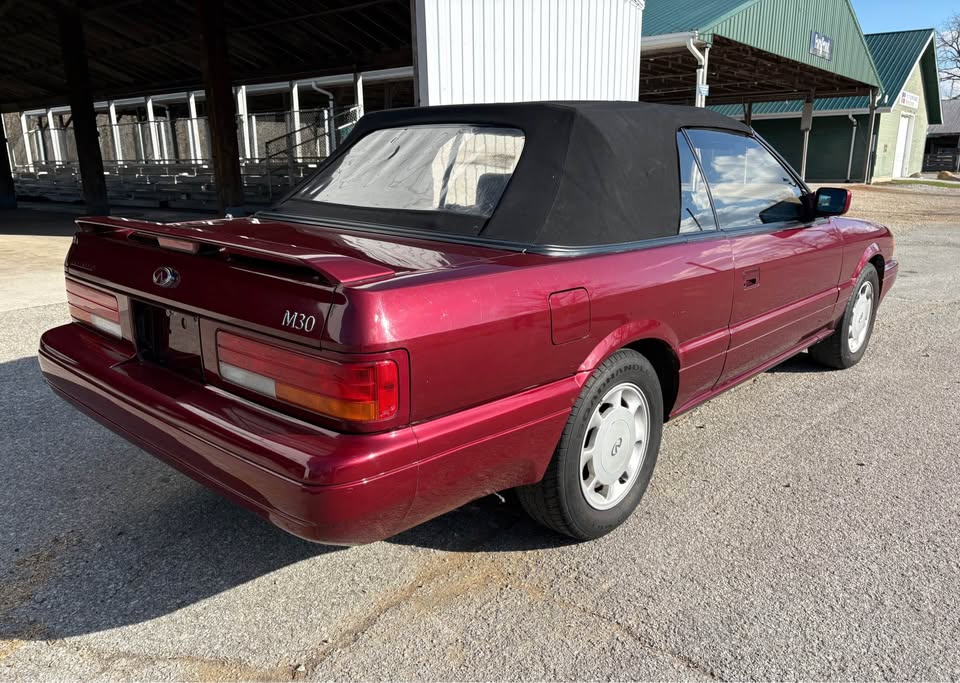
And so what about this particular car pictured here? I tripped across it on FaceBook Marketplace last night when my power was out and my iPhone was the best entertainment I could muster in a dark, warm, humid house. It’s located in Huntington, Indiana not too far from Fort Wayne, and at a remarkably reasonable asking price of just $5,400. I say remarkable because it has a scant 83,000 miles on the odometer, no obvious rust, the interior is not sunburnt/shredded like so many of these are, and the only issue that the seller calls out is that the power top must be operated manually – which according to this site may or may not be a big deal, but since it can be operated manually for this money I wouldn’t be losing sleep.

One of the tenets of being Totally That Stupid is finding what we think are good deals. I firmly believe this car falls into that category. Sure, I wouldn’t bring it to the Infiniti dealer for service (I’d wager that nobody working in their service department would even know what to do with it), but rather find a competent independent mechanic that knows his vintage Japanese stuff. Parts may take a little finding, but like with so many older cars the internet is your friend. In total, about 12,000 M30s were reportedly sold in the U.S., and most of them seem to be done and gone. That means you may be the only one you see in a year of casual car events, but there should be a decent number of used parts out there for the taking. Like those old Apple advertisements said: Think Different. This car is most definitely different – and I’d say in a good way.
 Totally That Stupid
Leave a comment