
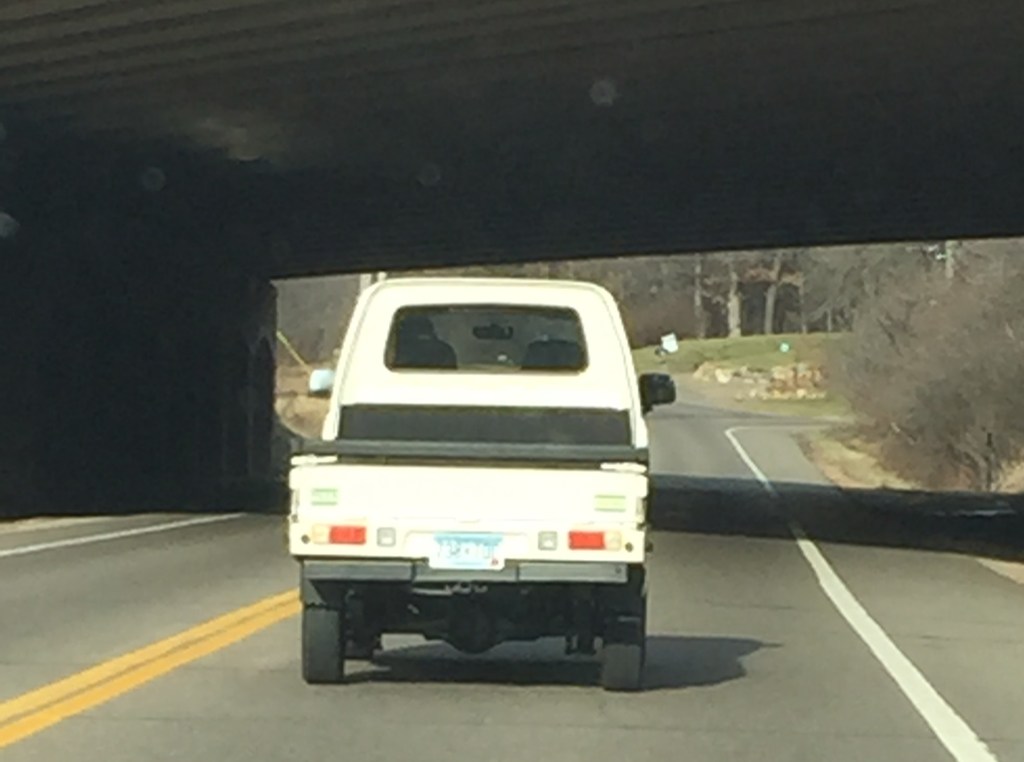

I consider myself pretty savvy when it comes to identifying weird cars. Monteverdi Hai? Renault 17TL? Mazda RX500? I had the Matchbox cars. Bitter CD? Nailed it. Drilling down a bit, how about the engine from a Daimler SP250? Well, what else looks like a miniature Chrysler 426 Hemi, but with SU carburetors?
However, the photo above, shot with an iPhone 5 almost eight years ago while driving on a fairly main road near my house, has been a total enigma. From the distance, the size suggested a Japanese kei pickup like a Honda Acty, Suzuki Carry, Subaru Sambar, etc. The image quality is clearly crap, but you can still make out the main features like – and the spatial relationships of – the tail and backup lights, the tailgate latches, the shape of the rear window, and the live rear axle.
Off and on for years I would futz around on Google, trying to figure out this cute little trucklet. At one point I turned to my friend and colleague Rob. Rob has probably forgotten more about JDM hardware in general – and Japanese mini-trucks in particular – than I will ever know.

Example: I was on a commercial shoot once in rural Oregon. Our film crew was based out of this local hoarder’s compound. Scattered everywhere were old trucks, collapsing buildings, vintage logging equipment, and a smattering of very friendly goats.
Among this fascinating and totally engrossing mess was a mini-truck I guessed was of Japanese origin. I couldn’t find any obvious badges around the body, and any interior emblems or signatures were long gone. I shot a photo and texted it to Rob. Immediately he replied, “Oh, cool. A Nissan Cony. Haven’t seen one in forever. Neat.” A Cony. Nissan. Sure, why not?
Thusly, I figured Rob would get this one right away. Nope. Anything he came up with I had already tried to match and failed. So the image sat, waiting, and eventually transferred to both my current iPhone as well as my laptop.
Recently, it came to my attention that kei trucks are illegal to plate for road use here in Minnesota. When this information landed, I was initially taken aback. How could they outlaw these cute little things? They don’t harm anyone, and other than during rush hour in the immediate Twin Cities, traffic is generally pretty light. At least they could be used on suburban and rural roads without any real danger.
Then I spent ten days in Hawai’i, where kei trucks are absolutely everywhere and used for everything. And, man, they are small. Toward the end of our trip I saw a Honda Acty van on O’ahu’s H1, a major and busy highway, late on a clear but fairly breezy evening. Dude was buzzing along at probably 50 mph in the far-right lane. I passed him at 70.
In that moment I realized kei trucks are probably a bad idea here in the Bold North. Why? Imagine being on I-90 through the plains of southern Minnesota in the dead of winter. In the snow. With a strong crosswind. And then in the limited visibility a snow plow comes along and punts you into next week. The driver assumes he hit a frozen expansion joint and keeps right on truckin’.

That brings us to last Thursday.
I was rummaging around in a folder on my computer desktop looking at images when I came across my mystery friend. I wasn’t feeling another deep-dive into its identity. “Dummkopf,” I thought. “Why don’t you just reverse image search it on Google? Have I really not already tried this?” Almost eight year plus two whole seconds later I had my answer.
Meet the Miles ZX40ST Work Truck.
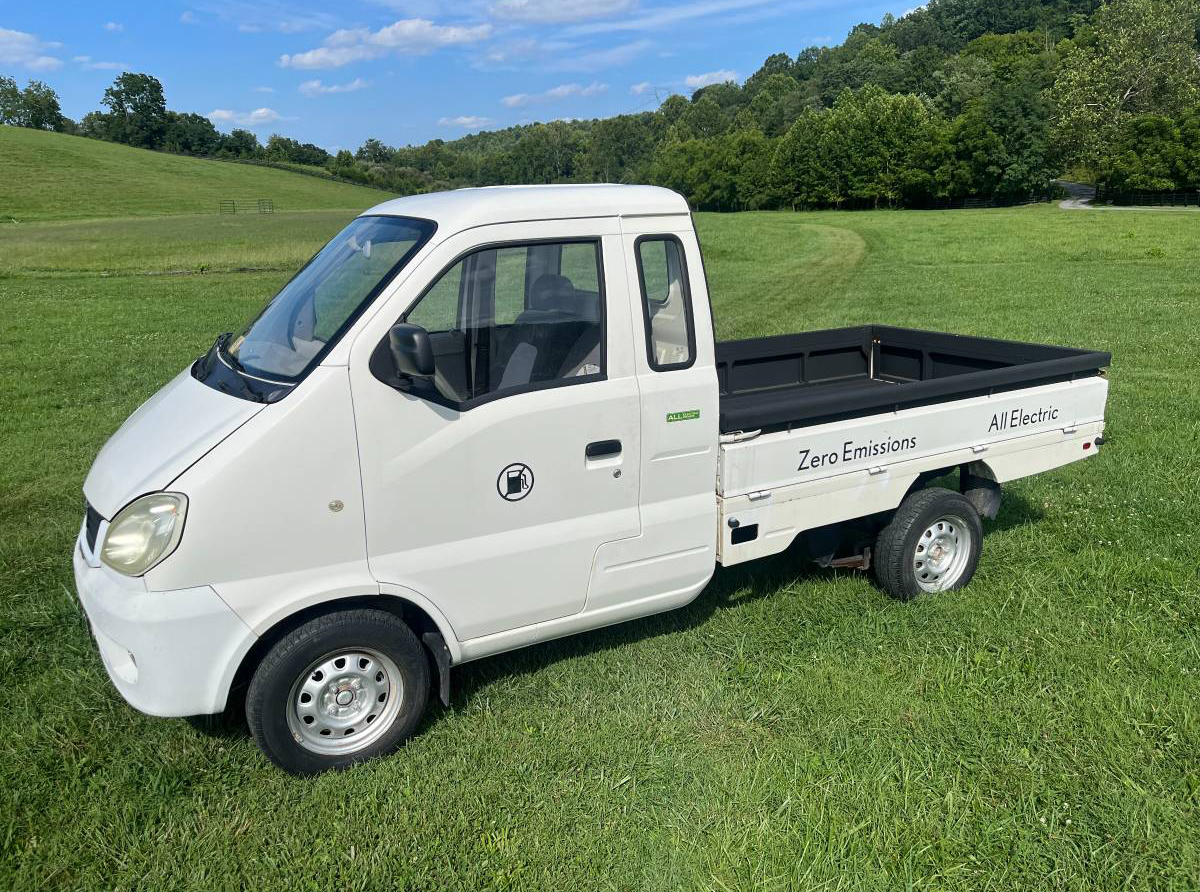
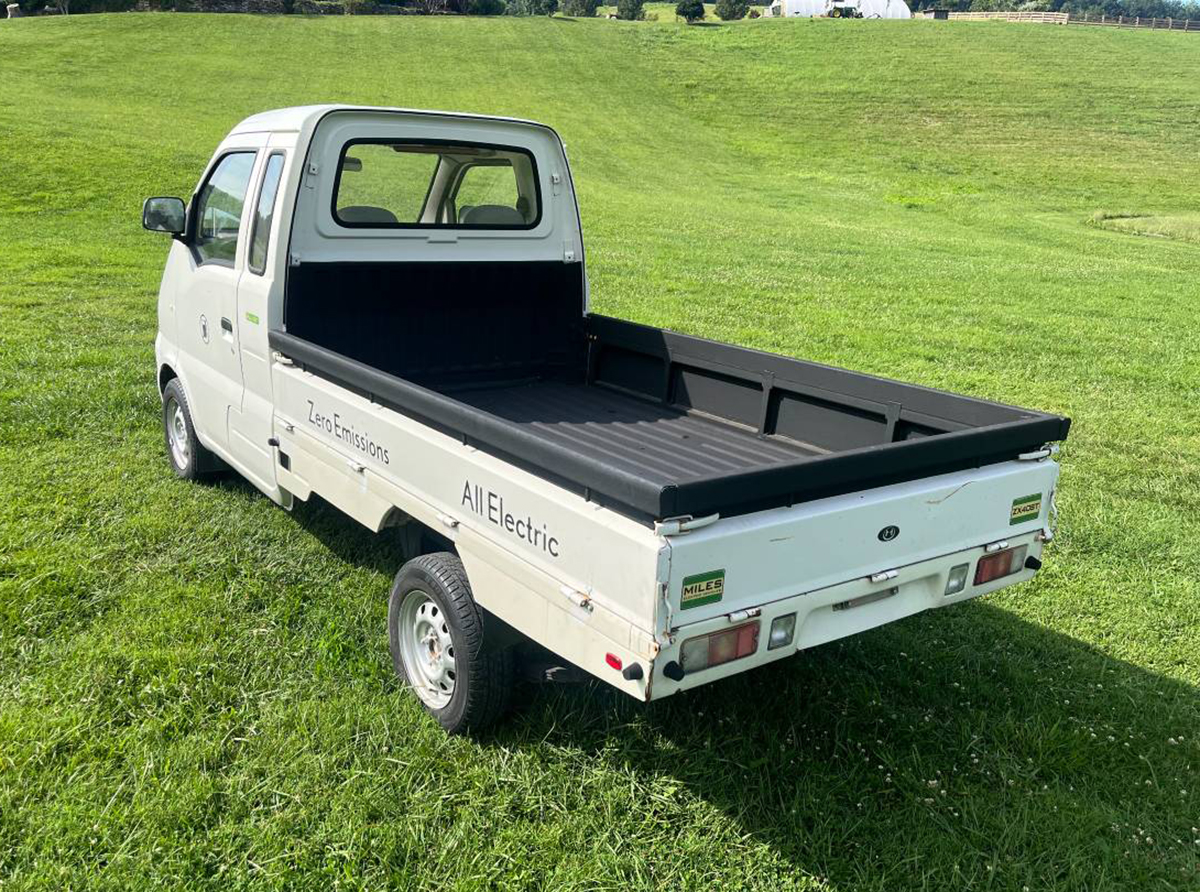
Introduced at the 2008 Green California Summit in Sacramento, California, the ZX40ST Work Truck was a collaborative product of Miles Electric Vehicles in the U.S. and Chinese manufacturing partner Hafei. A functionally useful but technologically primitive (by today’s standards) battery electric, juice was provided by six regular lead-acid forklift/golf cart batteries hidden under the bed. Range was somewhere around 60 miles. Charging time from dead on a 110-volt outlet could take up to 12 hours. Fast-charging? You’re pretty.
The ZX40ST started at $18,400 and featured regenerative braking and offered optional air conditioning.
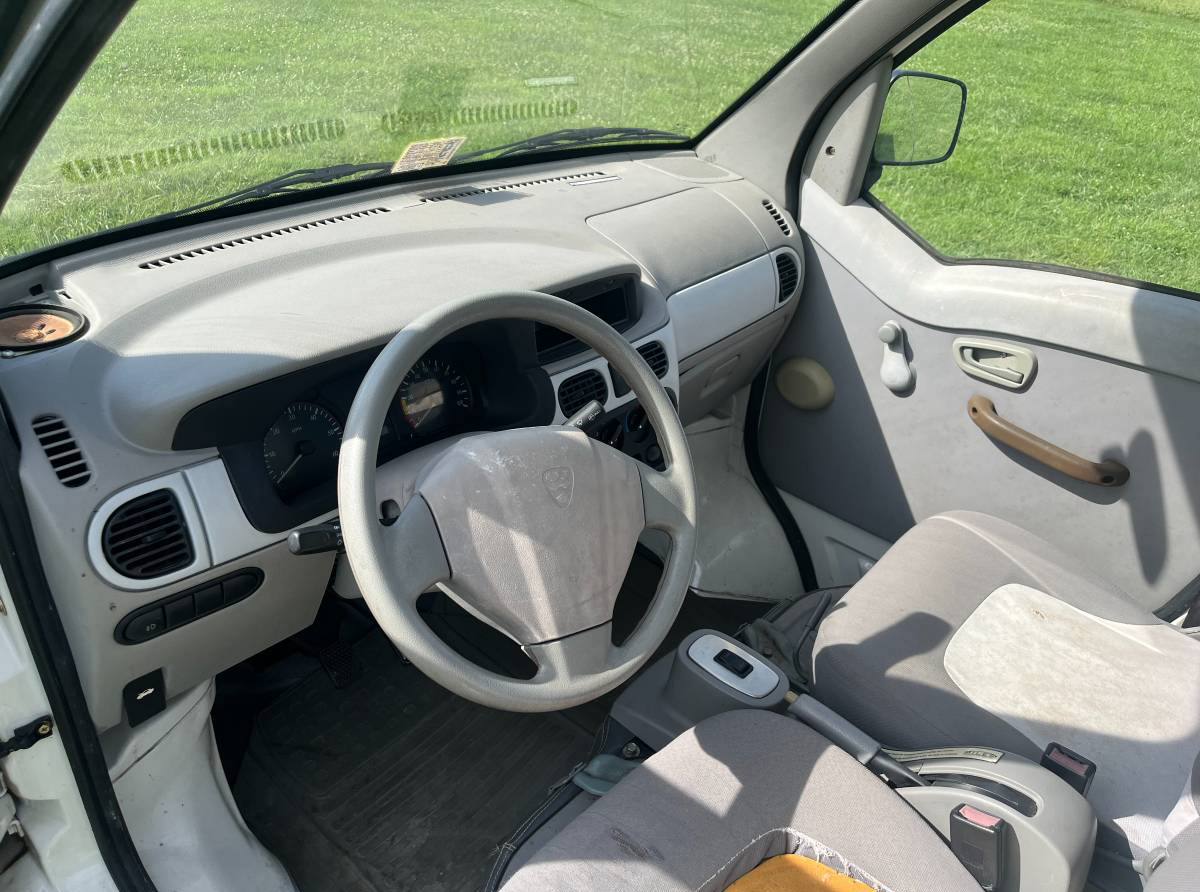
There’s more. From Wikipedia:
“All Miles Electric Vehicles were DOT/NHTSA Federal Standard 500 compliant, offering steel chassis, steel impact-resistant frame, steel doors and DOT-approved glass throughout. NHTSA/FMVSS Standard 500 law requires all low-speed vehicles (LSV) be electronically limited to 25 mph (40 km/h), and are street legal for use on roads with posted speed limits up to 35 mph (56 km/h).”
That road by my house? 35 mph limit. That truck in the photo? It was running Minnesota license plates.
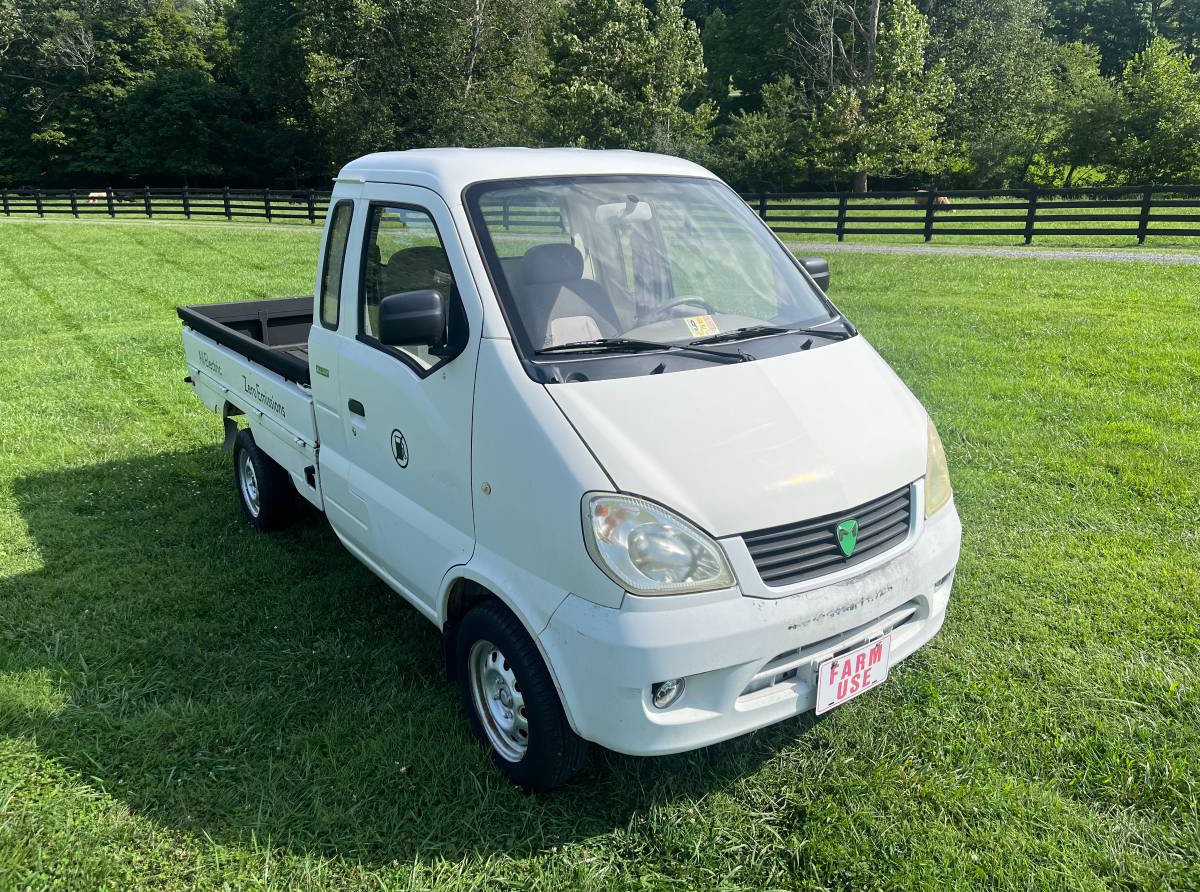
But that was in 2016, three years after Miles Electric Vehicles declared bankruptcy, leaving its customers twisting in the wind. Without parts or technical support, those who bought in – including NASA, the U.S. Navy, and various universities – were basically left to fend for themselves. After some amount of parts cannibalization, one has to assume the remaining trucks were junked or sent to auction.
They do still show up occasionally, however. A few minutes of poking around yielded a rescue from 2020, a home-built lifted ZX40ST from 2021, an auction from 2017, and someone looking for repair help in a DIY electric car forum (also from 2021).

I never saw that one in my neighborhood again. However, based on the above, I think if you really wanted one to play with, there still seem to be some out in the wild.
 Totally That Stupid
Leave a comment